Arts - Museums - New York Times
Their annual special on museums is so chock-full of information, I haven't had a chance to read everything. There are more than a dozen articles on museum topics ranging from antiquities to Alcatraz to kids' view of Jackson Pollock paintings. It's an excellent gathering of articles about a lot of the current issues for museums today.
Thursday, March 30, 2006

Tuesday, March 28, 2006
Teens, Art, and Museums
MoMA.org | Red Studio: A Site for Teens
The link goes to a website set up by the Museum of Modern Art that is both by teens and for teens. It includes teens' interviews with artists, an upcoming art contest, polls, art activities, and so forth. It looks like a good tool for art teachers, and may serve as a good prototype for other museums who want to work with teens and technology.
The link goes to a website set up by the Museum of Modern Art that is both by teens and for teens. It includes teens' interviews with artists, an upcoming art contest, polls, art activities, and so forth. It looks like a good tool for art teachers, and may serve as a good prototype for other museums who want to work with teens and technology.
Tuesday, March 21, 2006
It's a beautiful day at LRMA....
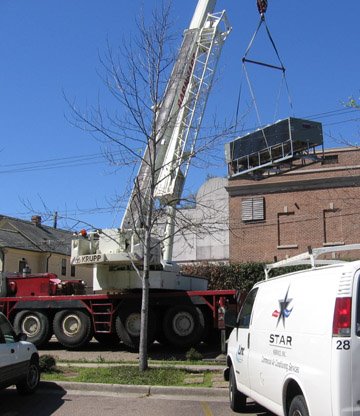
...perfect for cranes, utility trucks, and mechanical excitement. If you've ever wondered what it takes to keep 22,000 square feet of museum air conditioned in the brutal Mississippi summer, these pictures may answer that question. Our 20+ year old chiller wore out on us, and we got a new one today. Here's the crane:

Here, the old chiller is coming up and out:
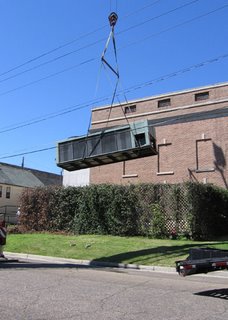
Here, the new one is going in:

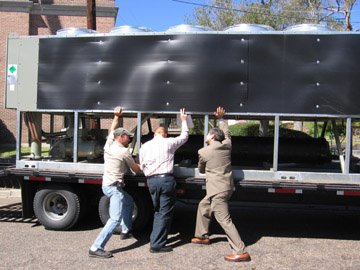
In an effort to save money, Todd, Mark, and George offered to do the moving themselves instead of using the crane:

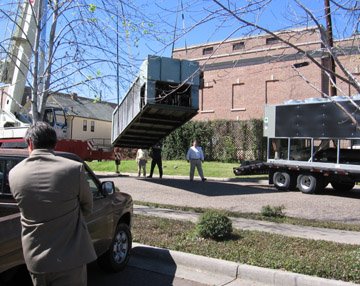
Here you see just how big these things are: the old one on the way down, the new one on the flatbed to the right:

This is merely one component of our complex HVAC system, which is designed to keep the artworks in optimal conditions. Artwork will last longest if kept at about 65 degrees, and about 50% humidity, which is why most people find museums a bit chilly.

Here, the old chiller is coming up and out:

Here, the new one is going in:
In an effort to save money, Todd, Mark, and George offered to do the moving themselves instead of using the crane:
Here you see just how big these things are: the old one on the way down, the new one on the flatbed to the right:
This is merely one component of our complex HVAC system, which is designed to keep the artworks in optimal conditions. Artwork will last longest if kept at about 65 degrees, and about 50% humidity, which is why most people find museums a bit chilly.
Friday, March 17, 2006
Spring Break Art Break: picture goodness

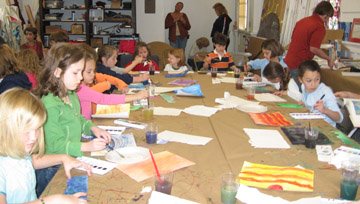
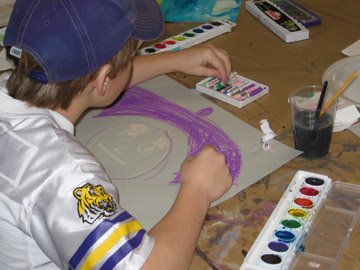
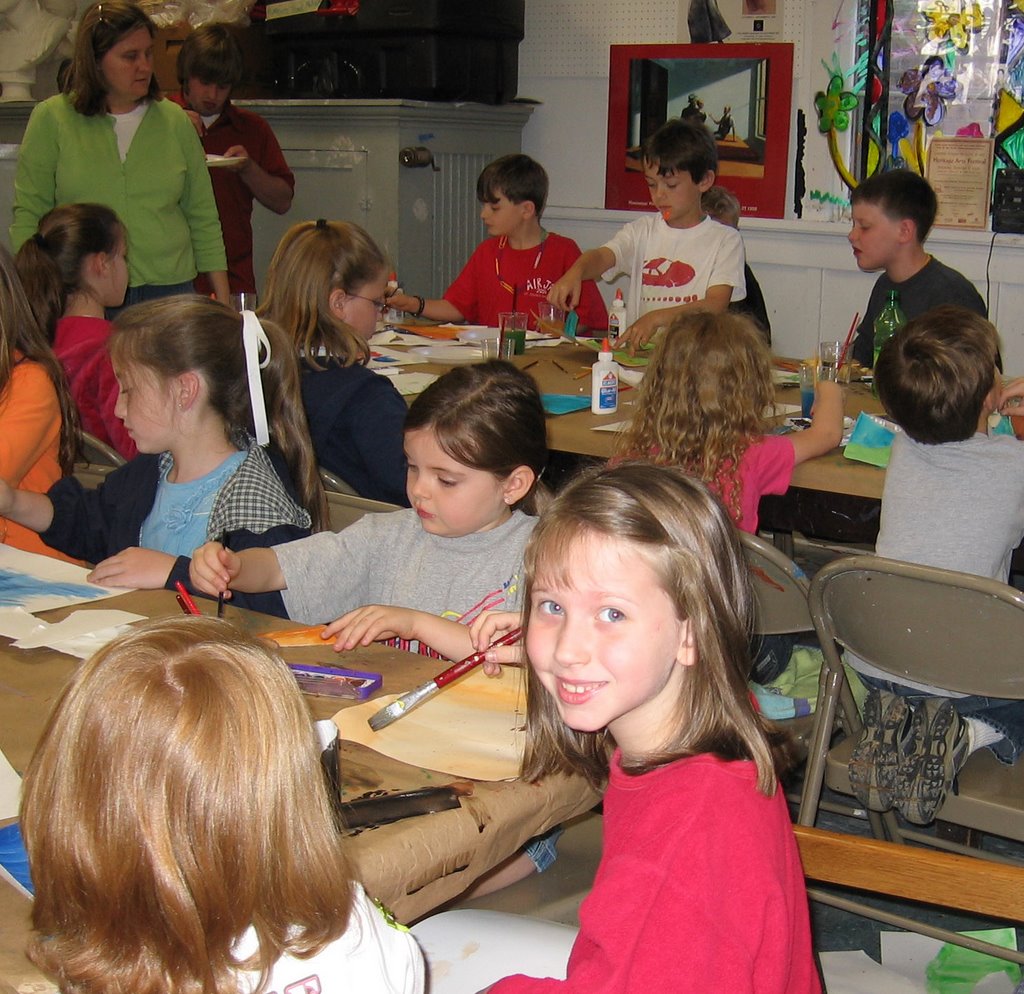
This Tuesday, Wednesday, and Thursday, the education department held art classes each morning and afternoon. The morning classes were for K-3rd grade, afternoon for 4th-6th grades. The students made collage and watercolor landscapes, visited the museum for a tour, and made self-portraits in pastel and watercolor.
Tuesday, March 14, 2006
Spring Break Art Break has Sprung
and as of now, all classes are full to the brim.
We'll post pics of the fun later this week.
We'll post pics of the fun later this week.
why study art history?
I read this on a listserv and reproduce it here because I think it's important to remember why we do what we do, why museums and art history are important:
"Off the top of my head, here's why I think one should study art history:
1. To become an educated person
2. To achieve visual literacy
3. To have historical referents for making sense of the world around you
4. To translate visual information into verbal form (both spoken and written)
5. To understand the past in the way historical peoples saw their cultures or wanted their cultures understood
6. To make sense of the present realities, one must be aware of how those realities became the way they are
7. To know how to research visual art to integrate our society with the distant and recent past
8. To comprehend how visual imagery communicates information
9. To understand the mechanisms of culture
10. To make the connections afforded by a liberal arts education and its different disciplines
11. To provide the reasons for societies to cohere
12. To recognize the motivations behind creativity
13. To become a better person
Anne Swartz, Ph.D.
Professor of Art History
Savannah College of Art and Design"
"Off the top of my head, here's why I think one should study art history:
1. To become an educated person
2. To achieve visual literacy
3. To have historical referents for making sense of the world around you
4. To translate visual information into verbal form (both spoken and written)
5. To understand the past in the way historical peoples saw their cultures or wanted their cultures understood
6. To make sense of the present realities, one must be aware of how those realities became the way they are
7. To know how to research visual art to integrate our society with the distant and recent past
8. To comprehend how visual imagery communicates information
9. To understand the mechanisms of culture
10. To make the connections afforded by a liberal arts education and its different disciplines
11. To provide the reasons for societies to cohere
12. To recognize the motivations behind creativity
13. To become a better person
Anne Swartz, Ph.D.
Professor of Art History
Savannah College of Art and Design"
Thursday, March 09, 2006
Spring Break Art Break!
There are still a few slots available for next week's Spring Break Art Break kids' classes!
click here for info:
Spring Break Art Break
Or just call the museum at 601-649-6374 and ask for Pam, who is in charge of registration.
click here for info:
Spring Break Art Break
Or just call the museum at 601-649-6374 and ask for Pam, who is in charge of registration.
Revising Art History's Big Book: Who's In and Who Comes Out? - New York Times
Revising Art History's Big Book: Who's In and Who Comes Out? - New York Times
The link goes to an interesting article about the state of the Big Art History Books that art historians use to teach introductory classes. Gardner, Janson, and Stokstad are the big three, and many professors use them as a foil, to "teach against." Everybody can read a survey book and be outraged that some person or some painting was "left out."
The Stokstad is my favorite, and not just because Marilyn Stokstad teaches at my alma mater and is a lovely person. I like it because it is inclusive, wide-ranging, and includes important historical and social information. Growing up in American culture, I have no basis for understanding a West African sculpture from the 18th century, so I need context. Likewise, kids raised in Protestant churches need context in order to understand art made in Catholic societies. And people raised in traditional Asian culture need historical and social context in order to understand Western art. Stokstad does a fine job of covering these bases without getting too far away from the artworks.
Having said that, I'll have to have a good hard look at the forthcoming Janson to see how it works.
*the New York Times requires registration to read articles, but it's free and can be anonymous.
The link goes to an interesting article about the state of the Big Art History Books that art historians use to teach introductory classes. Gardner, Janson, and Stokstad are the big three, and many professors use them as a foil, to "teach against." Everybody can read a survey book and be outraged that some person or some painting was "left out."
The Stokstad is my favorite, and not just because Marilyn Stokstad teaches at my alma mater and is a lovely person. I like it because it is inclusive, wide-ranging, and includes important historical and social information. Growing up in American culture, I have no basis for understanding a West African sculpture from the 18th century, so I need context. Likewise, kids raised in Protestant churches need context in order to understand art made in Catholic societies. And people raised in traditional Asian culture need historical and social context in order to understand Western art. Stokstad does a fine job of covering these bases without getting too far away from the artworks.
Having said that, I'll have to have a good hard look at the forthcoming Janson to see how it works.
*the New York Times requires registration to read articles, but it's free and can be anonymous.
Monday, February 27, 2006
Charles Crossley visits Laurel
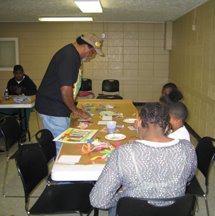
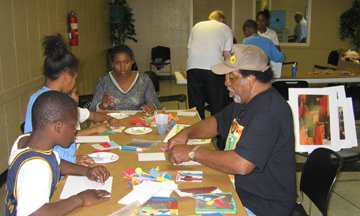
Charles Crossley, a multimedia/collage artist from McComb, Miss., visited Laurel last week. He and LRMA museum education staff held one workshop for kids in the after-school program at the Townley Center and one at the Alternative School.
Walt Grayson at LRMA

On Thursday, February 16, Walt Grayson of "Mississippi Roads" fame spoke at LRMA to a large and appreciative crowd. We have "Art Talks" the third Thursday of most months and lately we find ourselves moving them to our largest gallery, the American Gallery. Art Talks are free, open to the public, and we provide drinks and snacks. Click on the link to the museum website for info on upcoming speakers.
Thursday, February 23, 2006
Review of the Whitney Biennial
Have the Curators of This Year’s Whitney Biennial Finally Figured Out How to Make the Show Matter? -- New York Magazine
This year's biennial at the Whitney Museum of American Art in New York City opens next week. The venerable biennial has been in parts controversial, tedious, trendy, vilified, praised, and critiqued in every possible way. New York Magazine's Mark Stevens does a good job of tackling the meaning and method of the Biennial in general, and this year's in particular.
This year's biennial at the Whitney Museum of American Art in New York City opens next week. The venerable biennial has been in parts controversial, tedious, trendy, vilified, praised, and critiqued in every possible way. New York Magazine's Mark Stevens does a good job of tackling the meaning and method of the Biennial in general, and this year's in particular.
Wednesday, February 22, 2006
Good news from New Orleans
NOMA | New Orleans Museum of Art
After seven months, many layoffs (and some rehirings) and all the other devastation of Katrina, NOMA is reopening on March 3, 2006. This, to me, is a sign that New Orleans will rebuild, will survive, and that people there mean that the city will return to being the cultural mecca it has always been. Life without art is unthinkable; if the city is to survive, its music and art and literature must be nourished as well.
After seven months, many layoffs (and some rehirings) and all the other devastation of Katrina, NOMA is reopening on March 3, 2006. This, to me, is a sign that New Orleans will rebuild, will survive, and that people there mean that the city will return to being the cultural mecca it has always been. Life without art is unthinkable; if the city is to survive, its music and art and literature must be nourished as well.
Tuesday, February 21, 2006
Chihuly's lawsuit situation
The Stranger | Seattle | Features | Feature | Glass Houses
The link goes to a long and thoughtful article about the status of Chihuly vis-a-vis Chihuly, Inc., and the distinctions between artists, artisans, and so forth. Dale Chihuly doesn't blow glass, but has 150 employees that produce his work and manage the studio business (designers, PR, architects, packers, photographers, you name it). On the one hand, Rubens had the same kind of enterprise going, and nobody questions his role as the Artist. On the other hand, what is the status of Chihuly's senior glassblowers, whose artistry and skill infuse Chihuly's designs with life? What happens when one of his glassblowers goes to another company and starts making things that look "Chihuly-ish"? This is the contention of the lawsuit - that the rogue glassblower is knocking off Chihuly - but then again, glass blowers have been knocking off Chihuly for twenty years or more. It's an interesting read from Chihuly's hometown newspaper.
The link goes to a long and thoughtful article about the status of Chihuly vis-a-vis Chihuly, Inc., and the distinctions between artists, artisans, and so forth. Dale Chihuly doesn't blow glass, but has 150 employees that produce his work and manage the studio business (designers, PR, architects, packers, photographers, you name it). On the one hand, Rubens had the same kind of enterprise going, and nobody questions his role as the Artist. On the other hand, what is the status of Chihuly's senior glassblowers, whose artistry and skill infuse Chihuly's designs with life? What happens when one of his glassblowers goes to another company and starts making things that look "Chihuly-ish"? This is the contention of the lawsuit - that the rogue glassblower is knocking off Chihuly - but then again, glass blowers have been knocking off Chihuly for twenty years or more. It's an interesting read from Chihuly's hometown newspaper.
Monday, February 20, 2006
Andrew Crawford
Andrew Crawford is one of our favorite emerging artists, and he's got family ties to Laurel: his dad grew up here. Andrew's a sculptor in Atlanta, working in metal. We've got one of his sculptures in the LRMA collection, Fiddlehead , which evokes both the violin (fiddle) and the organic curve of the fiddlehead fern. He's got a show coming up at the Georgia Museum of Art, and the last time I ran into him, he was opening a show at the Mobile Museum of Art. Click here for more info: Andrew Crawford: Sculpture
Wednesday, February 15, 2006
Art with Hearts
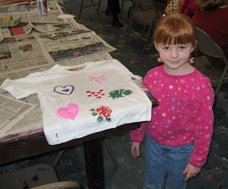


On Valentine's Day, Mandy and Mark with the assistance of Wes held holiday art classes. Here are a few pics of the classes and the artwork.The kids decorated cookies and t-shirts, and made custom valentine cards to take home.

Tuesday, February 14, 2006
Another museum blog: Eye Level
Eye Level
Updated no more than once a week or so, but always worth a visit, is the blog of the Smithsonian American Art Museum in Washington, DC. SAAM is in renovation, to reopen this summer, and they are ramping up their programs and online presence. My favorite recent post is the time-lapse video of the three days and many people it took to install one (very complex) artwork, James Hampton's The Throne of the Third Heaven of the Nations' Millenium General Assembly.
Updated no more than once a week or so, but always worth a visit, is the blog of the Smithsonian American Art Museum in Washington, DC. SAAM is in renovation, to reopen this summer, and they are ramping up their programs and online presence. My favorite recent post is the time-lapse video of the three days and many people it took to install one (very complex) artwork, James Hampton's The Throne of the Third Heaven of the Nations' Millenium General Assembly.
Friday, February 10, 2006
Lecture on the Biltmore today...

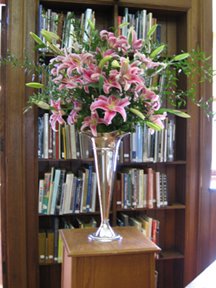
Today LRMA co-hosted a lecture by Betsy Baker of the Biltmore Estates. We may have more pics to post later, but herewith: visitors checking in at the museum lobby, and a gorgeous arrangement donated to the museum by the Laurel Garden Club.
Thursday, February 09, 2006
Installing "Pinturas de Fe"

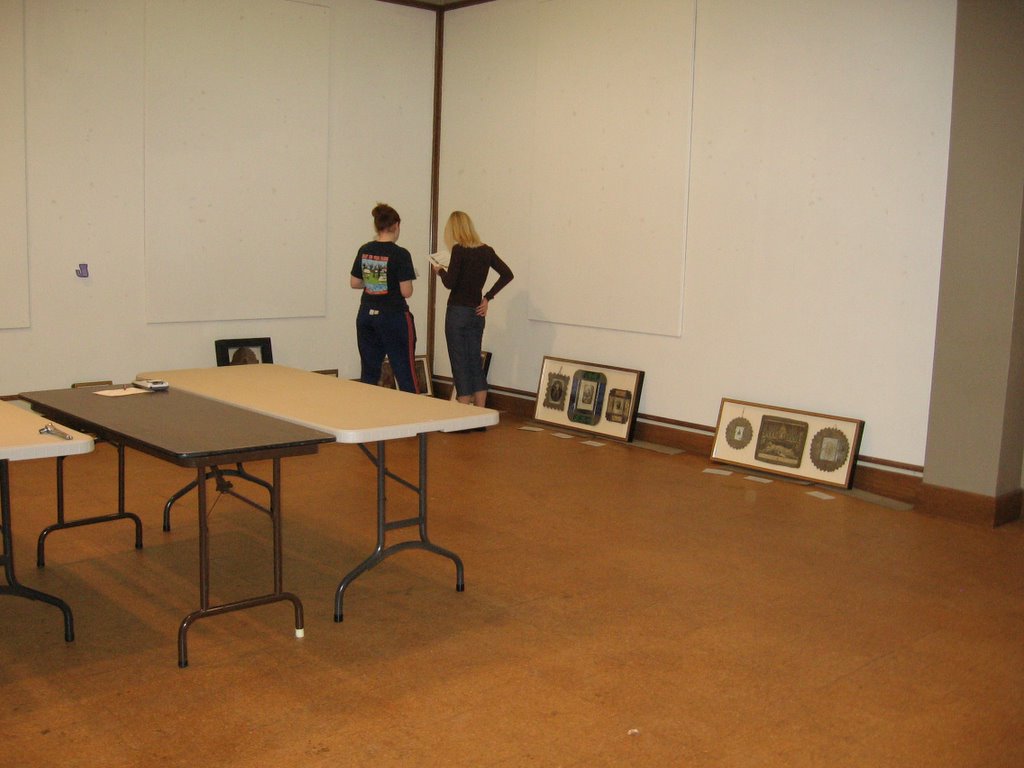
We are installing the new exhibition, "Pinturas de Fe: The Retablo Tradition in Mexico and New Mexico," this week. If I say so myself, the show is looking good. We thought it might be interesting to see a few shots of the installation process. Directly above is a photo of interns Katarina Dearman and Amber Lewis matching labels with retablos. Above and to the left: we have unpacked everything - retablos, photos, and text panels - and are ready to condition-report them. In a condition report, the registrar checks to be sure the items are in the same shape they were in when they were packed up. We'll do it again before we send them back.
and, bear with us: blogging is a new technology and I haven't quite figured out how to get the pictures to go where I want them.
Introducing: Live from LRMA
In which the staff of the Lauren Rogers Museum of Art keeps the public up-to-date with museum happenings. Classes, events, exhibitions, parties, you name it: we're here to talk about it.
Subscribe to:
Posts (Atom)
